
Lake Township City Directory Collections
The documented historical shelf is broader than a conventional city directory and more dependable for Lake Township research. Stark Library's Family & Local History department and the Probate Court repository inventory identify specific county indexes, date ranges, and access routes. The table leads with what has been verified. A blank in the city-directory column is meaningful: it is better to begin with an identified index than to attach a family to an unverified directory title.
| Collection | Years | Where held | Access |
|---|---|---|---|
| Lake Township Poll Book Index | 1858; 1874-1876 | Stark Library Index Files | Online index, then request a digital file or hard copy |
| Stark County tax indexes | 1810-1825; 1826-1829; 1830 | Stark Library Index Files | Index lead; confirm the underlying context with the library |
| Marriage, will, estate, birth, death, and naturalization material | Varies by series | Stark Library, Probate Court, and University of Akron | Microfilm, original repository research, court records center, or request |
| 1875 Stark County atlas and history index | 1875 | Stark Library and Ohio History Connection resources | Map landowner and road or section context before drawing a conclusion |
| Canton city-directory archive | 1859-1930, with gaps | Stark Library Community History Archive | Regional digitized context, not a complete Lake Township roster |
No official source inspected established a Lake Township city-directory publisher or year run, and none confirmed a reverse or criss-cross run for the township. That means no Polk collection, street-ordered shelf, publication gap, or end year should be invented here. Ask the library to identify any held Hartville, Canton, Akron, or rural-directory volume before treating it as coverage for a particular year.
Lake Township Historical Research Desk
Stark Library Family & Local History is the first practical stop for a historical Lake Township name. The department is published at Main Library, 1020 Market Ave. N., Canton, on the second floor, with assistance at 330-458-2765. Researchers can use in-person help, an online Request Assistance form, or a one-on-one appointment. Its research tools include Stark Memory and library genealogy resources, with some subscription resources available through a library card and Ancestry Library Edition available in the library.
The service point deserves a visit check. Stark Library announced that construction for its new Main Library began in June 2026 and that temporary Main Library operations are at 1020 Market Ave. N. The construction update explains why a researcher should confirm current access arrangements before making a trip.

Construction is an access-planning detail, not a change in custody: the library's historical indexes and Family & Local History help remain the right first route for identifying a documented volume, page, or collection.
Lake Township Historical Records Custodians
Lake Township family research often moves between repositories because the records themselves are divided. In 1988, the State Archivist and Stark County Probate Court transferred many of the court's oldest and most historically valuable series to University of Akron Archival Services and Stark County District Library after storage concerns. Estate case files since 1810 remain on microfilm at Probate Court. The split is a useful human research trail: a marriage or naturalization clue can direct a researcher to the library or Akron material, while an estate-file question may belong at the Probate Records Center.
The documented holdings are specific. Stark Library provides or holds the marriage index for 1809-1972 and marriage records for 1809-1916; birth material for 1867-1909; death material for 1867-1908; a will index for 1811-1942; naturalization material for 1861-1903; and administration and guardianship indexes. University of Akron has original birth and death records for 1867-1908, marriage dockets from 1809-1901, early marriage indexes, naturalization records, probate journals, and other transferred series. The correct repository depends on the record type and date, not on the postal wording of an ancestor's address.
Reading a Lake Township City Directory Index
A source citation tells more than a copied surname. The available sample inventory concerns verified indexes, not a reconstructed city directory entry. Record the exact citation first, then examine the original page, image, docket, or microfilm before deciding what it proves about a household.
| Poll-book index | A name-index lead for 1858 or 1874-1876; request the original poll-book page and its headings before interpreting residence or voter status. |
|---|---|
| Marriage index | Early and alphabetical indexes provide volume and page; the 1858-1972 alphabetical index includes both spouses' surnames. |
| Will index | Alphabetical names with a will and record volume or page citation. |
| Administration docket | Docket volume and page plus a case or file number that can point to the original proceeding. |
| Naturalization search | Name, arrival-year range, origin country, or vessel number can lead to Clerk docket and journal material. |
- Criss-cross directory
- A directory arranged by street or address rather than surname. A Lake Township run and dates were not verified, so ask library staff before relying on one.
- Householder index
- An index organized around the named household contact. It is not automatically a list of every person living at the address.
- Abbreviation key
- A legend printed in a particular volume that explains its symbols and short forms. Photograph or note it with the cited entry because meanings can vary by publication.
Lake Township City Directory Alternatives
For early Lake Township work, the targeted Poll Book Index is stronger than assuming a city directory existed. It covers only 1858 and 1874-1876, so it is a dated name lead rather than a continuous residence list. The Stark Library Index Files also identify tax indexes for 1810-1825, 1826-1829, and 1830. A tax listing may place a taxpayer in the county record system, but it does not by itself establish a family's daily residence or a property's occupant.
The 1875 Stark County atlas and its history index add geography. Use a landowner name, road, section, or nearby community to orient the question, then compare it against a deed, tax record, original probate citation, and the closest federal census schedule. Lake Township became independent in 1816 after Plain and Green context, so an early document can appear under a predecessor geography. Hartville, Uniontown, Greentown, Cairo, and Aultman can also appear as place clues without becoming proof of a modern municipal boundary.
Canton City Directories as Lake Township Context
The Stark Library Community History Archive provides a digitized Canton city-directory collection from 1859 through 1930, with gaps. It can help a researcher recognize a regional name, occupation-style listing, business, or address clue and may point to a family that moved between Canton and the township. It is not evidence of complete Lake Township coverage, and the archive does not support a claim that every township household appeared in Canton.
One inspectable 1912 Canton directory sample illustrates why a period volume is a clue rather than a certification: entries can contain name, residence, household, and occupation-style fields. Those fields must be read with the particular volume's context and checked against a census, a recorded deed, or a cited county record. Do not turn a city listing into a township roster or read an omitted name as proof that a person was absent.
Pairing Lake Township City Directory Clues
The sound Lake Township city directory workflow follows citations, not presumed annual listings. It can still build a useful household chronology when each source is allowed to say only what its original record supports.
- Begin with a person in a poll-book, marriage, will, tax, or naturalization index and copy the volume, page, docket, or file number exactly.
- Request or inspect the original image, microfilm, or record book from Stark Library, Probate Court, or University of Akron, according to the cited collection.
- Place a landowner or neighborhood with the 1875 atlas/history index and note the historical community or predecessor township wording.
- Compare the closest available federal census schedule through National Archives or library access channels to test household composition at the period date.
- Map an old legal description forward, then use the Stark County Recorder's deed trail and later parcel material only as confirmation of the property history.
If a directory volume is later identified by staff, add it as a dated supplementary source. A name that disappears might reflect a move, death, changed listing practice, a different jurisdiction, or an omission; only the linked original records can distinguish those possibilities.
Lake Township City Directory Context Sources
Lake Township Historical Society's curator guidance makes an important routing distinction. The society collects local manuscripts, publications, photographs, objects, and community history for Aultman, Cairo, Greentown, Hartville, and Uniontown, but it does not archive house or property records. Its books, yearbooks, narratives, cemetery guidance, and local place knowledge can enrich a family question; the Recorder, Tax Map, Probate Court, or Stark Library remains the custodian for the underlying governmental or archival record.
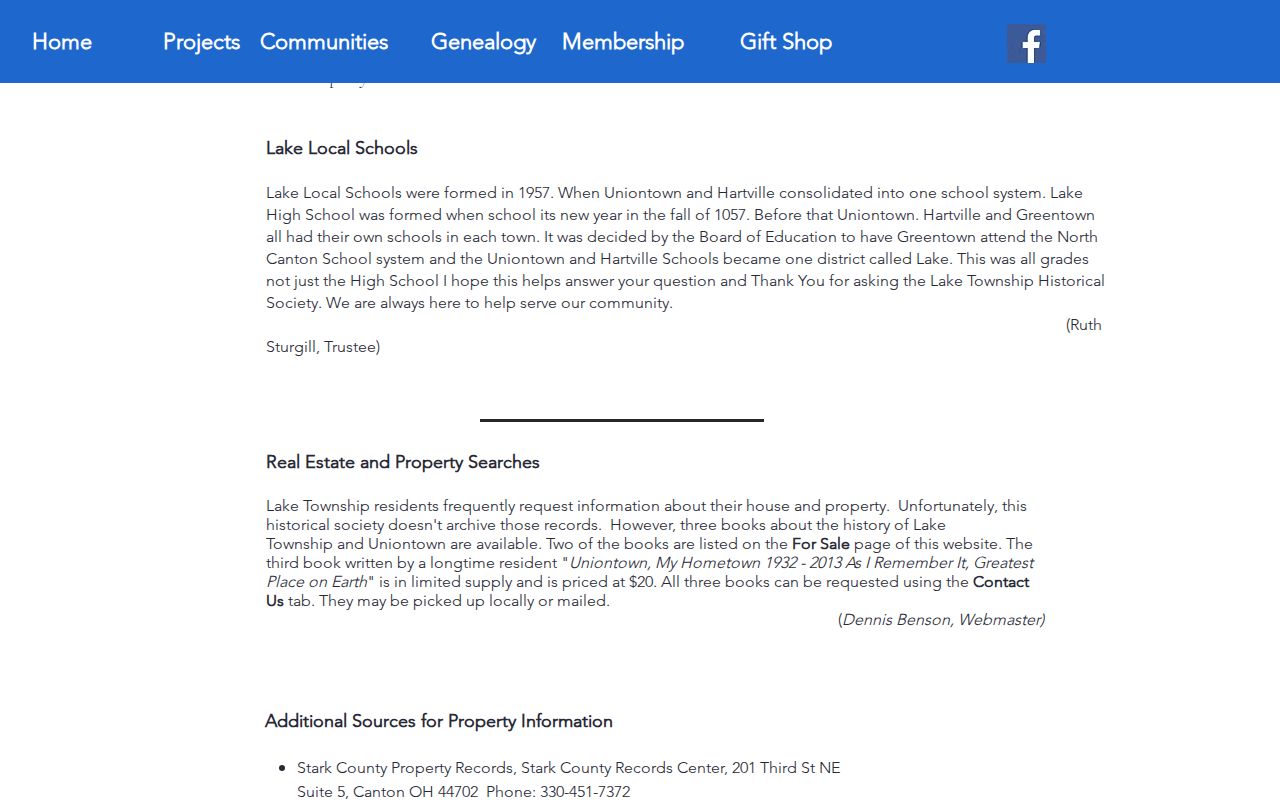
This division of roles prevents a common error: historical context can suggest where to search next, but a narrative or property referral does not replace the cited deed, probate entry, map, or original index page.
Lake Township City Directory Roster Limits
A historical directory is selective even when a precise volume exists. The available Lake Township research did not verify a local publisher, date sequence, or reverse directory, and the regional Canton archive has gaps. Poll books are limited to particular election years, tax indexes describe taxpayers, and marriage or probate materials document an event or legal proceeding rather than a complete household. A careful search therefore records the source, date, keeper, and unanswered question instead of filling gaps with assumptions. When an entry names a rural community or a postal place, retain that wording and test it against the period's township or county geography before assigning it to Lake Township.
For a current address question, move to the Lake Township By Street for the parcel-and-records workflow. For past address research, use Past Residents. These routes keep the historical shelf distinct from present-day records while preserving the geographic and family clues that make Lake Township research possible.